01What are presentation skills?
Presentation skills are the practical abilities that let you get an idea across to a room and make people care about it. They're not one talent but a bundle: organising your thoughts into a clear structure, using your voice and pauses to hold attention, standing and moving with confidence, cutting the filler words, keeping your nerves in check, and fielding questions without losing your footing. Charisma helps, but it's the smallest part – most of what looks like natural stage presence is simply a well-rehearsed set of habits.
And that's the encouraging bit: every one of those habits can be trained. Nobody walks into their first big talk with all of them in place. The people who present well have just run the reps – out loud, more than once, ideally with honest feedback. If you want to improve your speaking skills for meetings, pitches, lectures or the stage, you don't need a personality transplant. You need a handful of concrete techniques and enough practice that they hold up when the stakes are real.
02Who benefits from better presentation skills?
Far more people than you'd think present for a living without ever calling it that. The engineer walking a client through a proposal, the founder pitching investors, the teacher holding a class, the manager running the Monday stand-up, the student defending a thesis, the job candidate in a final-round interview – all of them live or die by how clearly and confidently they can put an idea in front of other people. In a remote-first world, the bar has actually risen: on a video call your voice, your framing and your pacing carry almost the whole message.
You don't need to aim for TED-talk polish to benefit. If your palms sweat before a status update, if you tend to read your slides word for word, if questions throw you off, or if you simply want to sound more convincing in the next meeting, these exercises are for you. Presentation skills compound: the same habits that steady a five-minute update are the ones that carry a keynote. Build them small and they'll be there when it counts.
03The most common presentation mistakes
The number one mistake is presenting the content instead of the message. Speakers dump everything they know onto the slides, read it out, and leave the audience to figure out what mattered. A presentation isn't a document – it's an argument with a spine. The second classic error is over-relying on slides: dense bullet points become a script, the speaker turns to face the screen, and the connection with the room breaks. Slides should support you, not replace you.
Three more traps show up again and again. People rush – nerves push the pace up, pauses vanish, and the audience can't keep up. They neglect the opening and closing, the two moments people actually remember, and drift into a flat middle instead. And they treat questions as an ambush rather than the most valuable part of the talk. The good news is that each of these mistakes has a direct, trainable fix – which is exactly what the following exercises give you.
047 exercises to improve your presentation skills
Work through these in order the first time – they build on each other, from the skeleton of your talk to the dress rehearsal. After that, pick the one that fixes your weakest link and drill it before your next presentation.
Build a spine: structure and story
Before you touch a slide, write your talk as three sentences: the one idea you want people to leave with, the two or three points that prove it, and a single opening image or story that makes them lean in. Audiences don't remember lists, they remember arcs – a problem, a turn, a resolution. A talk built on a clear spine survives a forgotten word, because you always know where you are and where you're going.
Voice and pauses: let the point land
Record yourself delivering your key sentence, then do it again and deliberately pause for a full second after it. To you that silence feels endless; to the room it signals confidence and gives the idea time to sink in. Vary your pitch and volume so the important words stand out – a monotone voice makes even great content forgettable. Pace, pause and emphasis are the levers that turn information into impact.
Body language: own the space
Stand with your feet planted shoulder-width apart, weight even, shoulders open, and let your hands gesture naturally at chest height instead of hiding in your pockets. Make real eye contact – pick two or three friendly faces and speak to them, not to the screen or the floor. Practise in front of a mirror or camera until an open, grounded posture feels normal. Your body tells the room how to feel about you before you say a word.
Cut the filler words
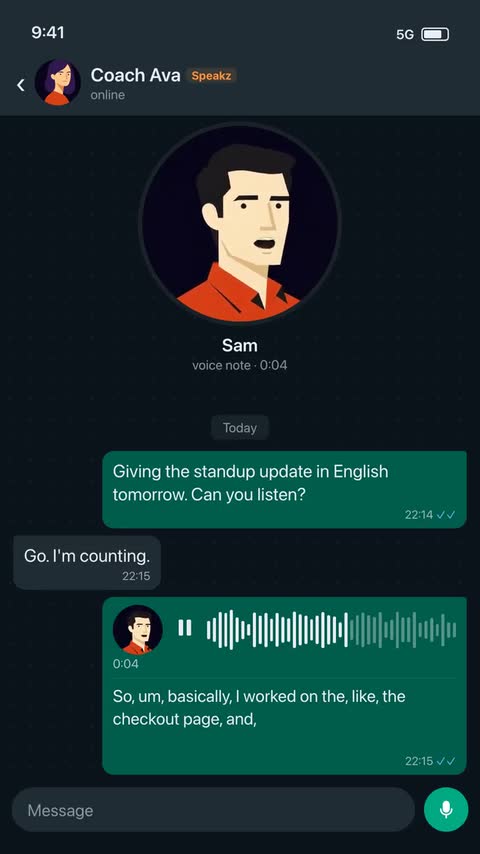
"Um", "like", "you know" and "basically" are voiced thinking pauses – your mouth filling a gap while your brain catches up. Record two minutes of yourself speaking freely and count them. Then replace each one with a silent pause: when you'd reach for an "um", simply close your mouth and breathe. It feels exposed at first and sounds composed to everyone else. Slowing your overall pace makes the gaps disappear before they start.
Channel the nerves
A racing heart before you present is normal and even useful – it's energy, not a verdict on your ability. Calm the body first: breathe in for four counts, hold for seven, out slowly for eight, twice, just before you go on. Then reframe the feeling: tell yourself "I'm excited because this matters" rather than "I'm terrified". The physical sensations of fear and excitement are nearly identical; the label you give them decides which one you feel.
Rehearse the Q&A
The questions are where credibility is won or lost, yet almost nobody practises them. List the five hardest questions you could be asked – including the one you're dreading – and rehearse a calm, honest answer to each out loud. Learn to buy a beat: repeat the question, pause, then answer. "That's a fair point, let me address it" is a complete sentence that gives you a moment to think. And "I don't know, but I'll find out" beats bluffing every time.
Run a full dress rehearsal
Once is not rehearsed. Deliver the whole talk out loud, standing, start to finish, with your slides and a timer – ideally in front of one trusted person or a camera. A silent read-through hides everything that actually trips you up: the pace, the transitions, the sentence that only sounds clumsy when spoken. The gap between a shaky presenter and a confident one is usually just a couple of full run-throughs the shaky one skipped.
05FAQ
How can I improve my presentation skills?
Pick one habit and drill it out loud. Start by giving your talk a clear spine – one core message and two or three supporting points – then rehearse it aloud, standing, at least twice. Add pauses so your points land, cut filler words by recording and counting them, and rehearse the questions you're dreading. The single biggest lever is practising the whole thing out loud rather than reading it silently.
What are the most important presentation skills?
Structure and storytelling, voice and pacing, confident body language, controlling filler words, managing nerves, and handling questions. Charisma matters less than people assume – most of what looks like natural presence is a set of trainable habits. If you had to prioritise, a clear structure and a well-rehearsed delivery carry the most weight.
How do I stop being nervous when presenting?
Work two levers. Calm the body with slow breathing – in for four, hold for seven, out for eight – just before you go on. Then reframe the feeling: "I'm excited because this matters" instead of "I'm scared". Nerves and excitement feel almost the same, so the label decides the experience. Thorough preparation and a couple of full rehearsals do more than anything to shrink the nerves in the first place.
How long does it take to get better at presenting?
There is no fixed timeline. Progress comes from practising out loud, so every talk you rehearse counts. Lasting confidence builds over a handful of presentations as the habits become automatic. The people who seem naturally good have simply run more reps – there's no shortcut around speaking out loud, but there's also no long wait.
Can you learn presentation skills, or are they a talent?
They're learned. Structure, pacing, posture, handling questions – every one is a technique you can practise, not a fixed trait. Even seasoned professionals rehearse and still feel nerves before going on. The difference is that they've built the habits and trust their preparation, which is exactly what these exercises are designed to give you.
Practice out loud.
Meetings, pitches, everyday talk. Speakz is free on iPhone, iPad and Android.
Get speakz. free